
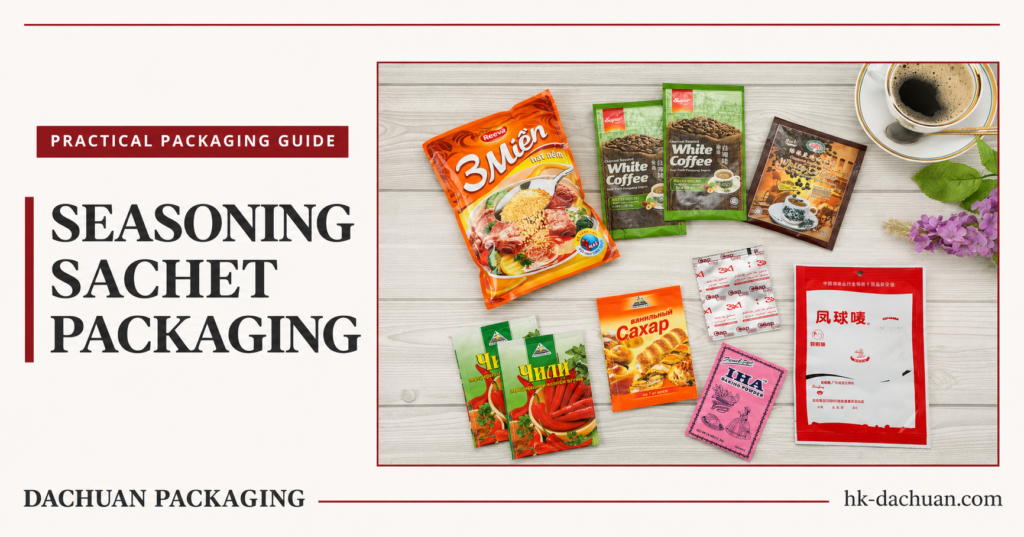
Seasoning sachet packaging connects a recipe portion with a small pack that must fill, open and dispense predictably. Start by identifying how the seasoning will be used: one preparation, several servings or a sample. The required quantity and use sequence should guide the dimensions rather than the other way around.
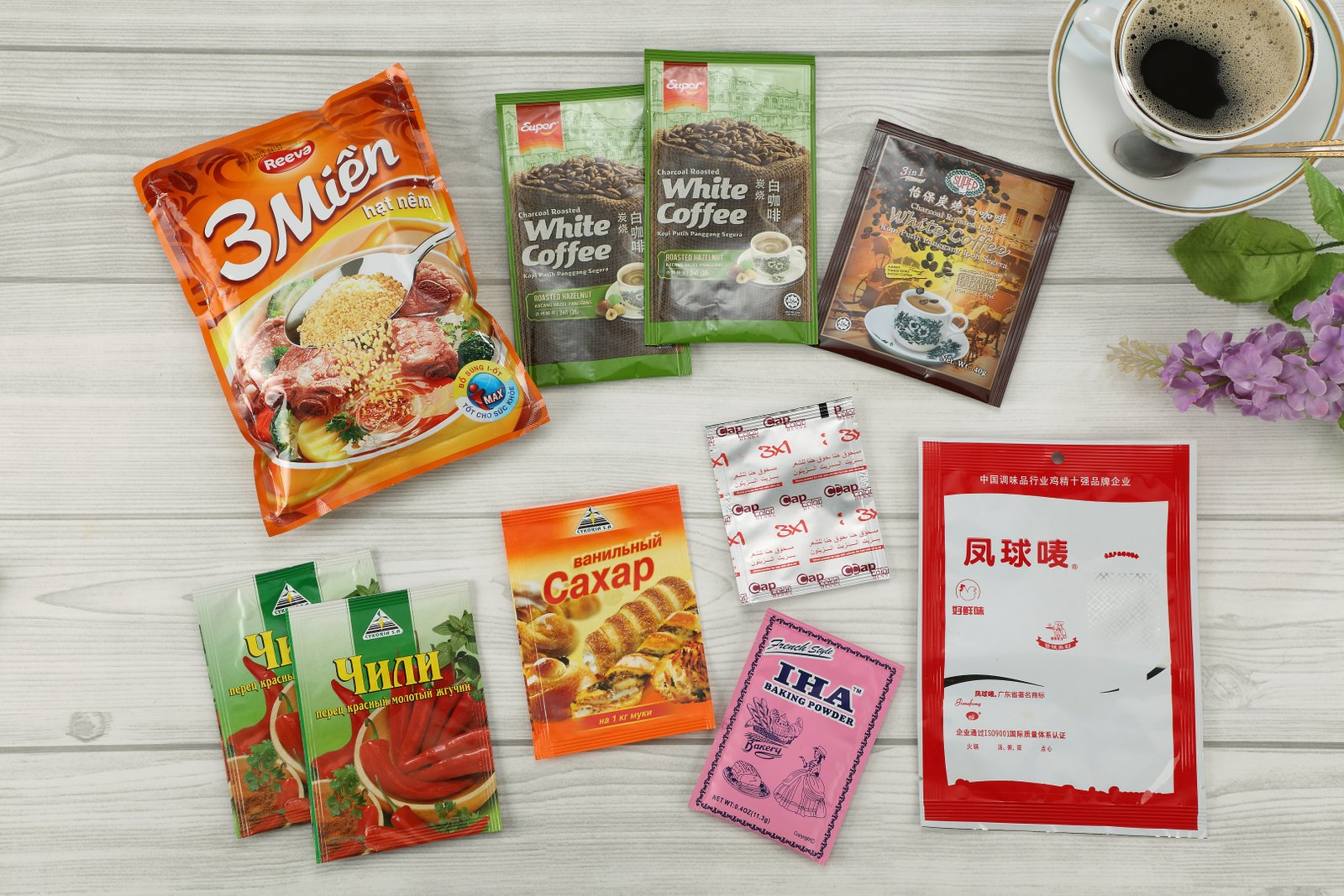
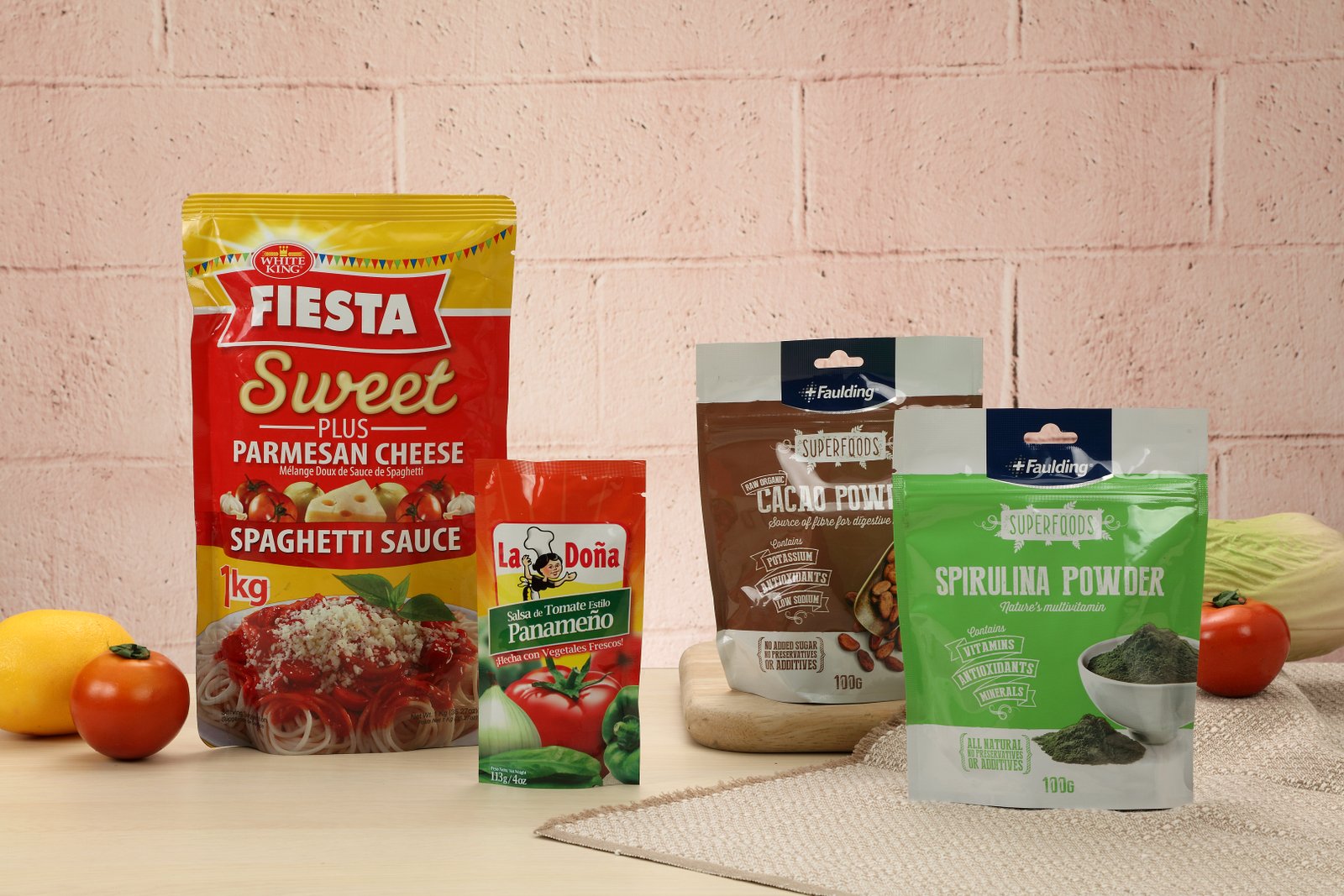
Seasonings also vary in particle size, flow and ingredient composition. A familiar sachet appearance does not establish the correct specification for a new blend. Dachuan Packaging’s catalog photographs offer visual references for food packets and other formats. Use the following nine decisions to turn that reference into a brief that the product team, supplier and filling partner can evaluate together.
1. Seasoning Sachet Packaging and the Recipe Portion
Define the preparation that one packet is meant to support and state the target fill quantity. Keep recipe instructions separate from the drawing so a preferred pack shape does not silently change the serving. Ask the product team to identify the blend version used for evaluation.
Provide a representative product sample where practical. Two blends at the same weight can occupy different volumes or behave differently during filling. Note whether the seasoning is fine, coarse or mixed rather than treating every dry product as one generic powder. That information helps the supplier discuss a relevant size proposal and lets the filler identify handling questions before a production commitment.
2. Assess Flow Before Fixing the Dimensions
Observe how the intended blend moves through the proposed filling arrangement. Include settling and any tendency for ingredients to separate in the product review. Ask the responsible team which observations matter to portion consistency and presentation.
Evaluate usable space with the actual blend rather than selecting dimensions from a similar-looking packet. Allow for seals, closure access and the filling process on a dimensioned drawing. A flat empty sample can communicate proportions but cannot demonstrate the behavior of seasoning sachet packaging under the intended fill conditions. Save the product reference and trial observations alongside the size proposal.
3. Describe Protection Needs Clearly
Explain the intended storage journey and the product team’s concerns about moisture, aroma or other changes. Ask for a proposed construction with information relevant to those concerns. Avoid treating a broad term such as high barrier as a complete technical specification.
The printed appearance does not reveal the full material structure. Request the proposed specification and identify how it will be evaluated with the intended contents. Any statement about product storage life needs relevant evidence; it should not be inferred from the existence of a metallic-looking layer. Keep the material proposal linked to the blend and conditions represented in the sample plan.
4. Choose the Supply Route with the Filler
Clarify whether the order will use pre-made packets or roll material for the agreed packaging process. Ask the filling partner to review the proposal early. A reel and a carton of finished empty packets transfer different tasks to the line and should not be compared as identical supply scopes.
Discuss the equipment details relevant to the selected route, including access, forming where applicable and final sealing. Use the proposed material and construction in a practical trial. Seasoning sachet packaging should be evaluated on the intended process rather than approved only because an unrelated pack previously ran on another machine.
5. Keep the Sealing Area Suitable
Review the path taken by the seasoning during filling and observe whether product reaches the intended closing area. Record the condition as a process observation, not simply as a judgment about film quality. The supplier and filler need the same evidence to investigate a question.
Agree which visual, mechanical and leakage checks are relevant. Keep sample preparation and any conditioning identifiable in the record. A clean-looking seal can support visual review, while other checks answer different questions. Select the evaluation plan with the responsible technical team instead of relying on a single unexplained performance number or an attractive catalog photograph.
6. Make Dispensing Match the Preparation
Ask users to open filled samples and pour the blend into the intended vessel or food preparation. Observe grip, tear initiation, opening shape and the last part of product removal. A narrow outlet may work differently for a coarse blend than for a fine powder.
Use instructions that match the approved opening arrangement. Record specific moments where the user needs to shake, squeeze or reposition the pack. These observations help refine seasoning sachet packaging around the actual preparation task. Keep a sample identifier with the feedback so that a revised opening is assessed against the same product and target quantity.
7. Plan Clear Identification and Instructions
Prioritize blend identity, variant and preparation information at actual printed size. Reserve relevant coding space with the filler and review the wording with the responsible product team. An artwork layout should help distinguish similar packets after they are separated from a carton or sample set.
Use the supplier’s approved dieline and keep important text clear of seals and cuts. If the recipe or portion changes, review both wording and dimensions. Do not assume a familiar brand layout is enough to release a new variant. The approved file needs an identifiable revision connected to the current product and construction.
8. Evaluate the Packet in Its Outer Pack
Decide whether the packets will be distributed individually, in recipe kits, in retail cartons or in food-service quantities. Review counting, identification and access in that actual arrangement. A loose packet approval does not settle every question about the complete distribution unit.
Confirm the quantity basis used in quotations and packing instructions. Pieces, sets and cartons should be stated clearly so that purchasing and production use the same scope. For seasoning sachet packaging in a mixed kit, verify the relationship between each variant and its instructions. Record the agreed packing arrangement alongside the individual packet specification.
9. Release an Identifiable Production Brief
Combine the blend reference, target quantity, drawing, material proposal, opening, artwork and evaluation plan into one controlled release. Identify technical, text and commercial approvers. Keep unresolved questions visible until the relevant person has answered them.
For future orders, compare changes to the approved baseline. A new blend, portion, filler or distribution route may require another review even if the front design stays similar. Seasoning sachet packaging benefits from a short decision record that explains what was tested and why the selected proposal was approved, rather than relying on a photograph and a request to repeat the same pack.
A practical planning example
Consider an illustrative recipe-kit brief containing two seasoning blends at the same target weight. One blend is fine and the other contains larger particles. The buyer should not assume that one packet size and opening will work equally well for both simply because the weights match.
The team reviews usable space, filling and pouring for each blend. Observations are recorded against separate sample references, while the artwork keeps the variants identifiable. If a change to the opening is proposed, the relevant use trial is repeated before release. This is a planning example rather than a reported customer project or a claim of improved recipe performance.
Keep the product versions, quantity, sample drawing, opening instructions and outer-kit arrangement together. That record gives the next seasoning sachet packaging discussion a practical starting point and identifies which decisions should be revisited when the recipe kit gains another variant.
Seasoning Sachet Packaging decision record
| Record | What to identify | Decision to capture |
|---|---|---|
| Product | Contents, version and intended quantity | Requirements confirmed by the product team |
| Package | Drawing, construction and opening | Approved specification and sample reference |
| Process | Filling, closing and handling conditions | Relevant trials and unresolved questions |
| Release | Artwork, quantities and commercial scope | Named approvers and current revision |
Seasoning Sachet Packaging FAQs
Can the same sachet size cover all seasoning blends?
It may be possible after evaluation, but weight alone is not enough. Review product volume, flow, filling and dispensing for the intended blends.
Does the packet photograph identify its material layers?
No. Ask for the proposed structure and relevant information, then evaluate it against the product and storage requirements.
Should the pouring trial use the actual blend?
Use representative contents and the intended vessel where practical. Particle size and flow can influence how the opening performs.
What belongs in a seasoning pack brief?
Include the blend version, target quantity, intended preparation, approximate format, filling route, artwork variants and known protection requirements.
Plan your next packaging discussion
Dachuan Packaging is based in Shantou, Guangdong, China. Share the product, intended format, fill amount, quantity and filling requirements through our packaging inquiry page. Include the decisions that still need supplier input so the team can discuss a relevant proposal and sampling route.
Continue with our related packaging planning guide, or browse the product catalog for visual references. For barcode planning, see GS1 Canada’s barcode guidance; for the role of seal-strength evaluation, see ASTM’s F88/F88M overview. Match external guidance to the actual application with the responsible technical team.