
Packaging batch traceability connects physical packaging and finished packs with the records needed to identify their history. A code printed on a packet is one part of that system, not a substitute for the links between supplier references, specifications, artwork versions and filling runs. Define those relationships before deciding how much information to place on a pack.
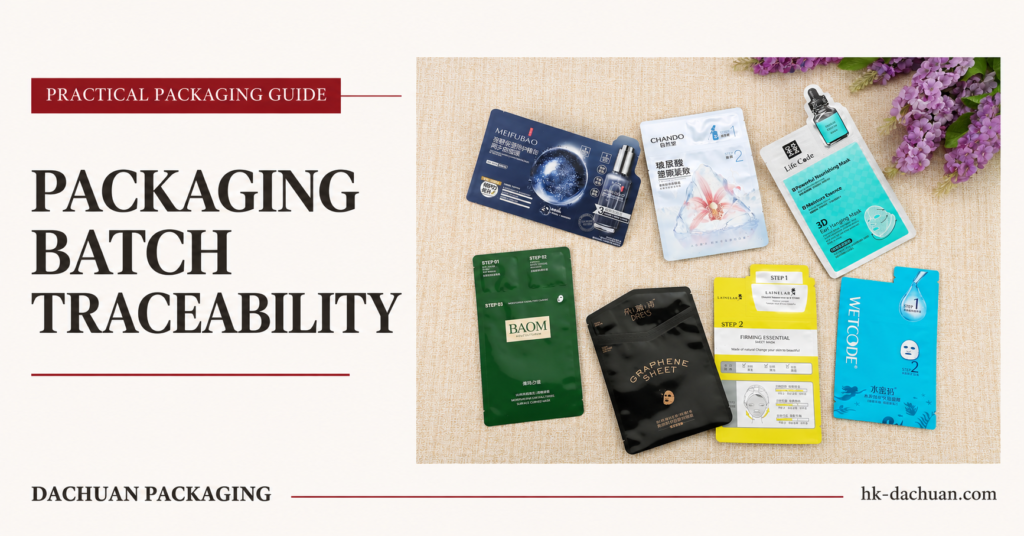
The catalog photographs in this guide illustrate printed packet and reel formats. They do not demonstrate a particular company’s traceability system. Use the nine planning steps below to identify the information your responsible operations and quality teams need, how it will be recorded and how a review can confirm that the links work for the actual purchasing and production arrangement.

1. Packaging Batch Traceability Begins with a Defined Scope
Identify which materials, products and operations the planned record system needs to connect. Describe the parties involved in receiving, converting, filling, packing and distribution as relevant. Avoid starting with a code format before the team knows which question that code must help answer.
Ask the responsible operations and quality teams to define the review purpose and relevant requirements. A system used to identify a material receipt may need different links from one used to review a finished product batch. Packaging batch traceability should make those relationships understandable without implying that a label alone establishes the completeness of the whole system.
2. Link the Material to the Approved Specification
Identify the construction, dimensions and relevant feature references associated with the packaging order. Connect the supplier’s material or lot reference to that approved specification. A similar-looking packet or reel is not sufficient evidence that the intended material was received.
Keep any accepted alternative or change identifiable in the record. If an investigation starts from a physical sample, the team should be able to determine which specification it represents. Record ambiguities at receiving rather than allowing them to persist through filling. This gives later production review a clearer basis than trying to reconstruct the material identity from the printed design or an informal order description.
3. Track Artwork and Variant Identity
Record the released artwork revision and the product or variant it identifies. Connect that reference with the packaging order and physical supply where appropriate. Similar front panels can belong to different versions, so appearance alone is a weak way to manage identification.
Ask the responsible team how obsolete or superseded files are distinguished from the current release. Keep the change record understandable to the supplier and filler. Packaging batch traceability benefits from explicit artwork links because a material can be technically familiar while carrying text that belongs to another product, market or earlier version. Review content identity alongside the construction reference at the relevant approval stages.
4. Record Receiving and Storage References
Define which information will be captured when the packaging arrives and how the physical supply will remain identifiable in storage. Include relevant supplier references, quantities and specification checks. State quantity units clearly so receipts are not confused across reels, pieces or cartons.
Ask the operations team how partial quantities, separated cartons or opened reel supplies will be identified. The information should remain useful after the original outer arrangement changes. Keep receiving observations and any unresolved difference connected to the physical supply. These records help a later review identify what was available for production rather than relying on a memory of which delivery looked like the expected order.

5. Connect Packaging Supply to the Filling Run
Identify how the selected material reference will be recorded against the actual filling or packing operation. Include the product version and relevant run identifiers defined by the responsible team. The goal is a usable link between the input and output, not a list of codes stored without relationships.
Review how the record handles changes of material, artwork variant or run conditions during production. Ask who records the information and when it is checked. Packaging batch traceability should reflect the actual workflow, including handovers between parties, so the relevant history can be reviewed from either an input material reference or a finished-pack identifier.
6. Plan Variable Coding with Production
Discuss where variable information will be applied and how it will be checked. Reserve a suitable area in the artwork according to the process requirements identified by the filler or printer. Keep the coding decision connected to the approved package construction and orientation.
Have the responsible product and quality teams define what information is required rather than inventing a universal code for every application. Check legibility and placement on the actual proposed pack. A code that is present but difficult to associate with the correct record weakens the purpose of the system. Save the released layout and relevant coding instructions with the production baseline.
7. Use Standards References in the Right Context
GS1’s published identification resources distinguish product identification from additional data such as batch or lot information. Use relevant official guidance with the responsible technical teams when defining a system that uses those standards. Do not treat an arbitrary printed number as proof of standard conformity.
Confirm which data and carriers are appropriate to the actual application. Keep human-readable information, machine-readable information and internal record links understandable together. Packaging batch traceability is a planning and verification task, not simply a graphic element added to a pouch. The system should be reviewed against its intended scope rather than described through unsupported claims about a barcode or a software feature.
8. Test Whether the Record Links Work
Select an identified sample or record and review whether the relevant history can be followed through the defined scope. Ask the team to demonstrate the connections rather than only confirm that separate documents exist. Note gaps and ambiguous handovers.
Keep the exercise tied to an actual workflow and agreed review purpose. A receiving reference that cannot be connected to a filling run may need a process change, not a larger label. Record observations and responsibilities for any improvement. Repeat the relevant review after the change so the team can confirm that the specific gap was addressed without assuming broader results that were not evaluated.
9. Maintain the System through Changes
Identify how changes to suppliers, specifications, artwork, coding or production partners will be reflected in the records. Preserve the relationship between old and new references where the responsible team requires it. A new file or code should not silently replace the meaning of an earlier production record.
Assign responsibilities for maintaining and reviewing the agreed information. Packaging batch traceability needs continued alignment with the real purchasing and filling arrangement, especially as variants and handovers grow. Keep the system specific enough to answer its defined questions while avoiding unnecessary claims that the existence of several records automatically proves a complete, verified supply-chain history.
A practical planning example
Consider an illustrative printed-reel receipt that is split between two filling runs. The supplier lot reference remains the same, while the product operation creates separate run records. A useful review asks whether each finished output can be connected to the material used and whether the remaining reel supply stays identifiable between runs.
The operations team documents the relevant relationships and checks the handover. If a gap is found when a partial reel leaves its original outer packing, the identification process can be revised and checked again. The issue is the missing record link, not necessarily the visual design of the consumer label. This is a planning example, not a report of a particular company’s system or compliance outcome.
Save the scope, material and artwork references, receiving record, run links and coding instructions together. Those details give the next packaging batch traceability review a specific workflow to assess rather than a collection of unrelated numbers on labels and documents.
Packaging Batch Traceability decision record
| Record | What to identify | Decision to capture |
|---|---|---|
| Product | Contents, version and intended quantity | Requirements confirmed by the product team |
| Package | Drawing, construction and opening | Approved specification and sample reference |
| Process | Filling, closing and handling conditions | Relevant trials and unresolved questions |
| Release | Artwork, quantities and commercial scope | Named approvers and current revision |
Packaging Batch Traceability FAQs
Does a printed batch code establish complete traceability?
No. The code must connect with the records required for the defined system scope, including relevant material and production relationships.
Should artwork versions be linked to packaging records?
Keep the released product and variant identity identifiable alongside the material specification so similar designs are not treated as interchangeable versions.
Can every product use one universal coding layout?
Have the responsible teams define the relevant information, process, placement and standards context for the actual application.
How can a traceability plan be checked?
Review whether identified inputs and outputs can be followed through the agreed workflow, record gaps and verify the relevant links after changes.
Plan your next packaging discussion
Dachuan Packaging is based in Shantou, Guangdong, China. Share the product, intended format, fill amount, quantity and filling requirements through our packaging inquiry page. Include the decisions that still need supplier input so the team can discuss a relevant proposal and sampling route.
Continue with our related packaging planning guide, or browse the product catalog for visual references. For barcode planning, see GS1 Canada’s barcode guidance; for the role of seal-strength evaluation, see ASTM’s F88/F88M overview. Match external guidance to the actual application with the responsible technical team.