
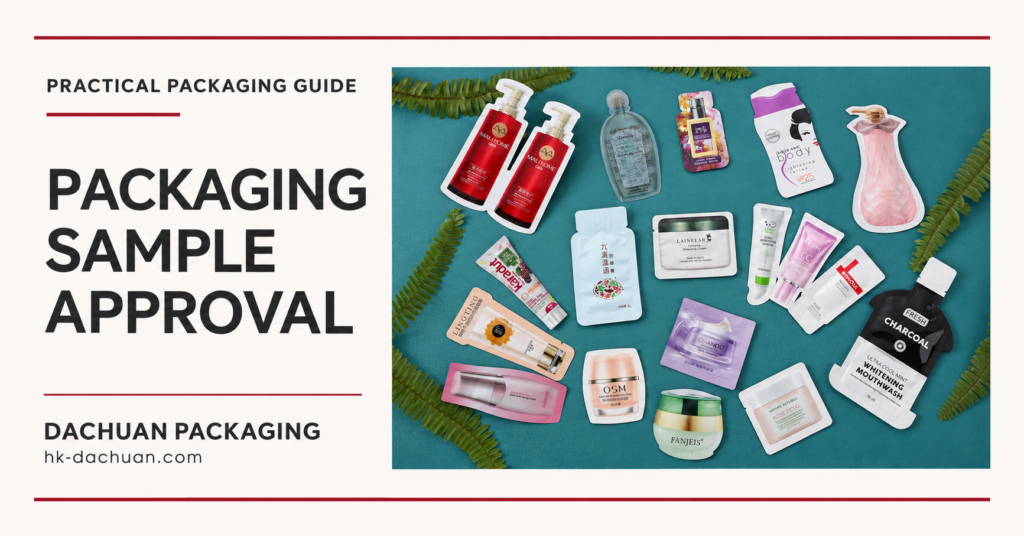
Packaging sample approval is a decision about an identified sample and the questions it has been used to evaluate. A catalog example, blank structure, printed proof and filled trial can each provide useful information, but they do not represent the same evidence. State the purpose of every sample before asking the team to approve it.
The most practical approval process connects the product brief, drawing, material proposal, artwork and filling operation. This guide follows nine stages for organizing that work. Use it to define what each reviewer is approving and what remains unresolved, rather than treating a favorable response to a photograph as a complete release for custom production.

1. Packaging Sample Approval Starts with a Question
Write down what the next sample must help the team decide. The purpose might be evaluating a silhouette, checking product capacity, reviewing artwork or running a filling trial. Different questions may require different sample stages, so do not request one unspecified “final sample.”
Share the decision with the supplier and internal reviewers before samples are prepared. Ask which aspects the proposed sample represents and which it does not. A stock example may be useful for tactile discussion while differing from the intended construction. Packaging sample approval becomes more reliable when every positive observation is tied to a clear question and does not silently expand into a broader claim.
2. Distinguish the Sample Stages
Label catalog examples, structure samples, layout proofs, printed samples and filled trial packs clearly. Record any differences from the proposed production specification. A familiar-looking sample is not automatically a production equivalent.
Ask the supplier how the sample was made and what should be reviewed on it. If a proof represents artwork placement but not final color on the selected material, keep that limit explicit. If a filled pack uses a substitute product, identify it in the record. These distinctions help purchasing, design and technical teams use samples effectively without assuming that every decision has been answered at the earliest visible stage.
3. Create a Traceable Sample Reference
Give each sample or sample group an identifier connected to its drawing, material proposal and relevant artwork revision. Record preparation dates and the product version where applicable. Keep the identifiers visible in photographs and written observations.
Avoid relying on informal descriptions such as “the larger bag we liked.” Several similar samples can circulate through a project, and a missing reference makes later approvals difficult to interpret. A simple register is often enough if it records the right information consistently. Packaging sample approval should allow another reviewer to identify exactly which item was assessed and which specification it represented when the decision was made.
4. Review Structure with the Contents
Use relevant contents and an agreed fill amount when assessing capacity, shape and access. Check dimensions against the drawing and include the chosen opening or closure. A flat unfilled sample can support a structural conversation, but it does not show every filled-pack behavior.
Record specific observations about filling, standing, grip and product removal as relevant to the application. Separate preferences from requirements. For example, a preferred front-panel proportion may be negotiable, while a fixed receiving-container opening creates a functional constraint. This distinction helps the supplier revise the proposal without losing the purpose of the pack or repeating trials that do not answer a new question.

5. Run the Intended Use Sequence
Observe the user’s sequence from first contact to product removal and any intended reclosure. Ask first-time users to follow the proposed instructions rather than explaining each action in advance. Record where they hesitate or choose an unintended opening.
Evaluate the actual product consistency and components where practical. A mask, powder and liquid create different handling tasks. Use the observations to discuss the opening feature, dimensions and information hierarchy together. Packaging sample approval is stronger when it includes evidence of the planned task, not simply a favorable general impression. Save the sample reference with the observations so the resulting changes can be checked on the next revision.
6. Connect Trials to the Filling Process
Involve the filling partner and record the conditions used to prepare trial samples. Confirm which equipment and product version are represented. An evaluation made on an unknown process can leave important questions about final sealing or handling unresolved.
Agree the relevant checks and acceptance criteria with the responsible technical teams. Keep visual review, seal behavior, leakage and product-contact questions distinct where appropriate. When a problem is observed, investigate the package and process together. Document changes to the material, construction or operation before repeating the relevant check. That record makes the new evidence meaningful rather than treating the next sample as an unexplained replacement.
7. Approve Artwork for the Correct Construction
Review text, graphics, coding areas and barcodes on the production template tied to the approved structure. Evaluate the layout at actual printed size and keep important information clear of the supplier’s seals, cuts and folds.
Assign text approval to the responsible product team and clarify how print appearance will be referenced. A digital preview may answer a placement question without representing the final result on a selected surface. Record the released artwork revision and remove ambiguity about which file is approved. Packaging sample approval should connect structural and artwork decisions so a later dimension change does not leave an obsolete printing file in circulation.
8. Record Decisions and Open Items
Summarize the observations, decisions, required changes and unresolved questions for each review stage. Identify the responsible person for the next action. A short, organized record is more useful than a long message chain containing conflicting informal approvals.
Ask reviewers to state the scope of their approval. Commercial acceptance of a quotation does not establish technical suitability, and artwork approval does not automatically release a new material construction. Keep those decisions connected but clearly attributed. When an item remains open, identify how it will be resolved and which evidence is needed. That prevents the project from advancing on an assumption that someone else already completed the required evaluation.
9. Release a Controlled Production Baseline
Combine the approved specification, drawing, artwork, relevant sample references and evaluation record into one release package. Confirm which commercial and technical conditions must be satisfied before production begins. Keep the release identifiable for the supplier and filling partner.
For future orders, compare requests with that baseline and record proposed changes explicitly. Decide which previous evidence remains applicable and what should be revisited. Packaging sample approval is a repeatable process rather than a one-time signature attached to a photograph. A clear baseline supports practical discussions about substitutions, variants and repeat production while preserving the reasoning behind the original decisions.
A practical planning example
Consider an illustrative custom-shaped cosmetic sample. The brand first approves a visual outline, then discovers during a filled trial that the opening is difficult to grip. The original visual approval is still useful evidence for appearance, but it does not resolve the functional issue. The next revision should address that identified opening question.
The team labels the revised sample, tests the intended contents and records the result. Any resulting contour change is reflected in the production drawing and artwork template before release. The final record distinguishes the approved look from the construction and use evidence. This scenario describes a review approach, not a reported customer project or measured commercial result.
Keep a decision register with the sample reference, review purpose, observations, approver and remaining actions. That small administrative step makes packaging sample approval easier to explain and repeat when another variant or a future production order uses the same design family.
Packaging Sample Approval decision record
| Record | What to identify | Decision to capture |
|---|---|---|
| Product | Contents, version and intended quantity | Requirements confirmed by the product team |
| Package | Drawing, construction and opening | Approved specification and sample reference |
| Process | Filling, closing and handling conditions | Relevant trials and unresolved questions |
| Release | Artwork, quantities and commercial scope | Named approvers and current revision |
Packaging Sample Approval FAQs
Is approval of a catalog sample enough for custom production?
It can establish a visual preference, but confirm which differences remain between that example and the proposed custom specification. Complete the relevant later evaluations.
Can one sample answer every packaging question?
Not necessarily. Structure, print appearance, filling, contact and use may need different sample stages or evaluations with clearly stated purposes.
What should happen after a sample change?
Identify the new revision, explain what changed and agree which previous checks remain relevant and which need to be repeated.
Who should sign off a production release?
Assign the required approvals in advance. Product text, technical suitability, artwork and commercial scope may be reviewed by different responsible people.
Plan your next packaging discussion
Dachuan Packaging is based in Shantou, Guangdong, China. Share the product, intended format, fill amount, quantity and filling requirements through our packaging inquiry page. Include the decisions that still need supplier input so the team can discuss a relevant proposal and sampling route.
Continue with our related packaging planning guide, or browse the product catalog for visual references. For barcode planning, see GS1 Canada’s barcode guidance; for the role of seal-strength evaluation, see ASTM’s F88/F88M overview. Match external guidance to the actual application with the responsible technical team.