
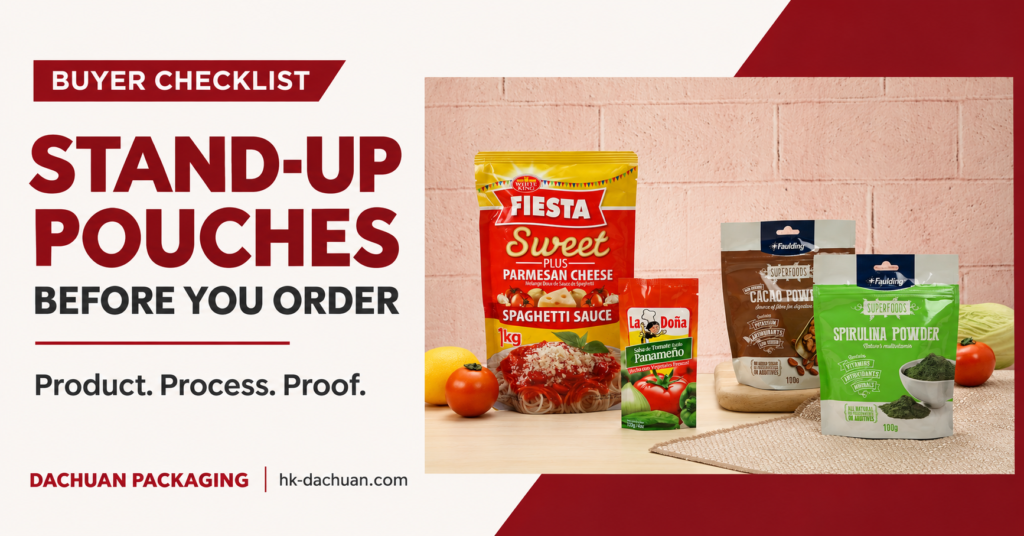
Buyer checklist · Dachuan Packaging
A stand-up pouch provides a base that can support an upright display when the pack and contents are suitable. The format is a starting point, not a guarantee of shelf stability, barrier performance or filling-line compatibility. Two pouches that look alike can behave differently in use.
Dachuan Packaging’s catalog includes stand-up pouch photographs for food products and household or personal-care applications. Use those images to explain the presentation you want, then turn that visual reference into a clear purchasing brief.
1. Describe the product before choosing the pouch
State whether the contents are a powder, granule, paste or liquid. Supply the intended fill weight or volume and any known sensitivity to storage conditions. Note whether the product will be filled at ambient temperature or through a different process; do not assume an ordinary pouch is suitable for heating, freezing or another demanding use.
A photograph does not reveal the complete material structure. Ask for a proposed construction based on your contents and process. Where protection targets are important, define the required measurements and test conditions with the packaging team rather than accepting a broad label such as “high barrier.”
2. Check usable volume and finished dimensions
Discuss the finished width, height and bottom gusset using a dimensioned drawing. Clarify how each dimension is measured. The same stated width and height can leave different usable space when seals, gusset construction and closure placement differ.
Test the intended fill amount in a physical sample. Check headspace, opening access, filled-pack shape and upright stability on the intended display surface. A nominal volume alone does not establish the behavior of your actual product.
3. Specify the opening and reclosure experience
Choose features according to use. A zipper may be relevant for repeated access, while another application may need a different opening method. Confirm the location of tear notches, the space above the closure and the ability to grip the pack. Reclosure is not a substitute for validating the pack’s initial seal.
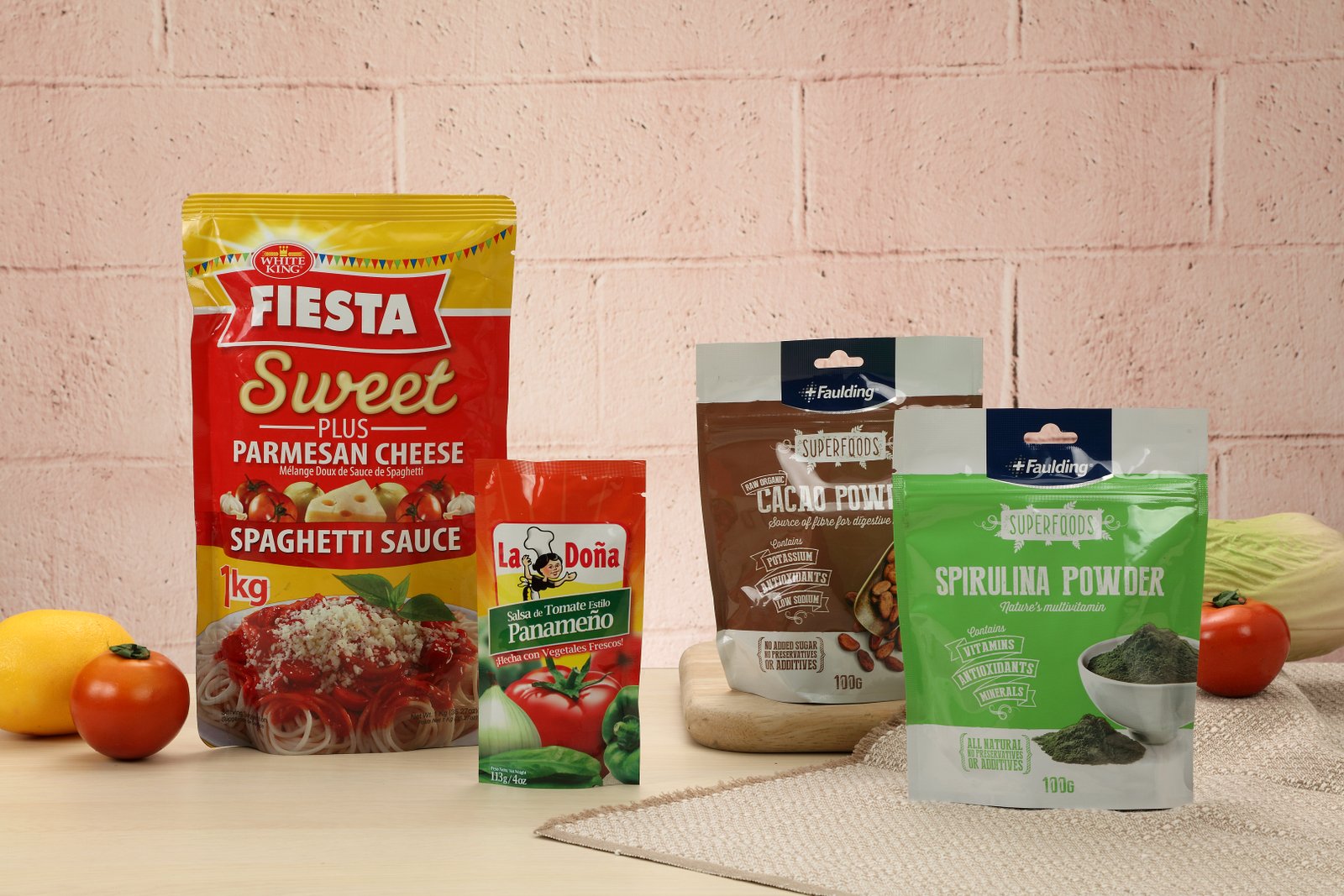
The food pouch photograph, catalog reference 294A4632, shows different pack presentations. It should not be used to infer one common closure, construction or process rating for every pictured item.
4. Keep food and household specifications separate
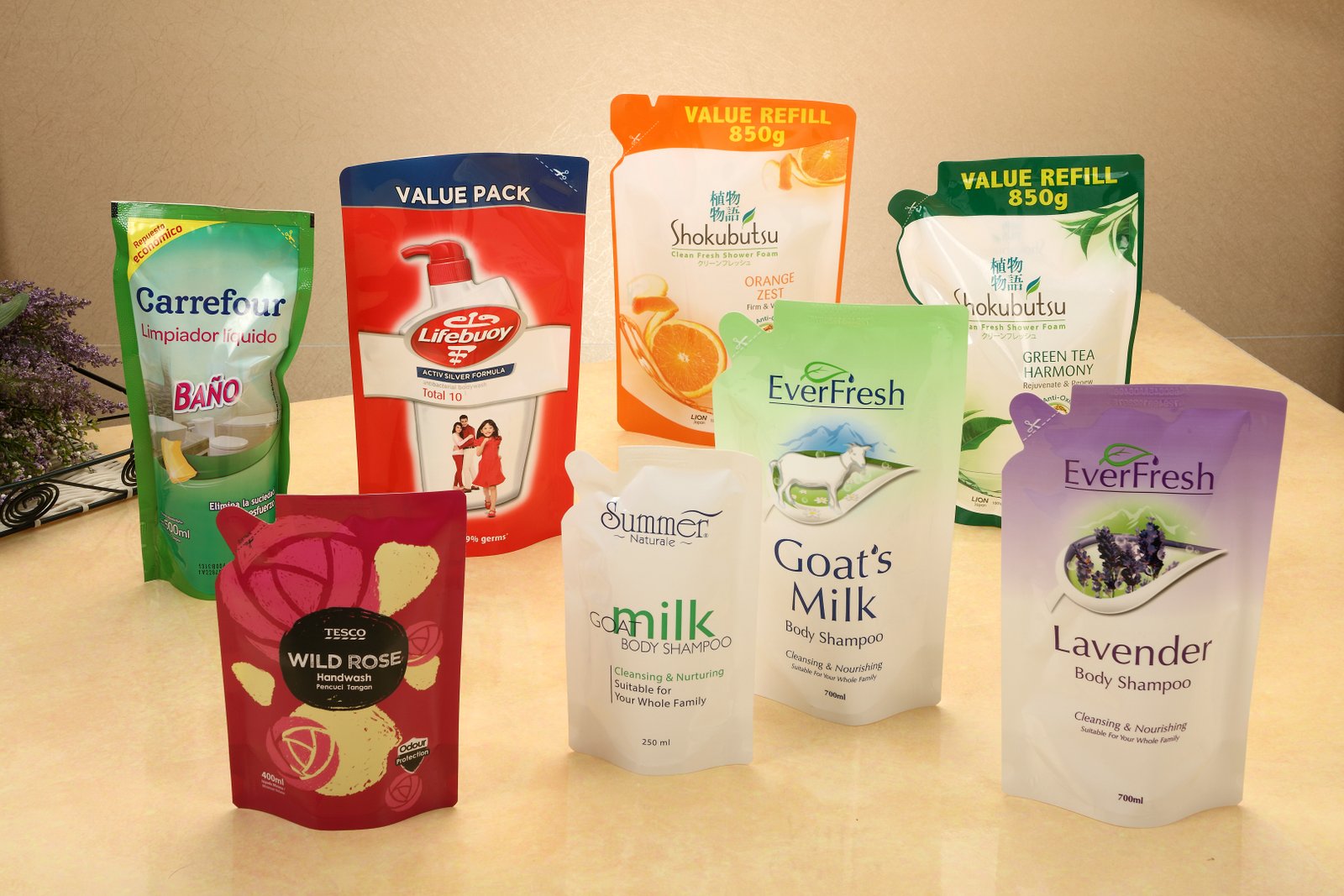
The household and personal-care catalog photograph, reference 294A4630, illustrates another use of the standing format. A household refill brief may prioritize formula compatibility, handling and controlled pouring. A food brief may involve different product-protection and documentation requirements.
Discuss the actual formula and use conditions with the supplier. Do not transfer a specification between unrelated products simply because the pouch shape is similar. Refill positioning also does not, by itself, establish recyclability or a measured environmental benefit.
5. Approve artwork on the correct production template
Request a dieline that shows the trim, seals, folds, gusset and closure areas. Keep required text and barcodes clear of these features. Inspect the layout at actual size so that small text is reviewed as it will appear on the pouch.
Ask how color references will be agreed and which proof represents which part of the process. A screen image can help approve layout, but it does not establish the final appearance on a selected material and finish. Record the approved artwork revision with the packaging specification.
6. Agree how samples will be evaluated
| Item | Evidence to request | Practical review |
|---|---|---|
| Dimensions and capacity | Dimensioned drawing and sample | Fill amount, headspace, standing behavior |
| Material and protection | Written proposed structure and relevant data | Suitability for contents and intended storage |
| Sealing and handling | Agreed sample test plan | Seal behavior, leakage and transport handling |
| Artwork and finish | Approved template and revision | Legibility, placement and agreed color reference |
Seal strength and leak evaluation answer different questions; agree which checks the application needs. For example, ASTM F88/F88M is a standard test method concerning seal strength of flexible barrier materials. Referencing it here does not mean a pictured pouch has been tested or certified to that method.
Document the sample revision, filling conditions and acceptance criteria. When a specification changes, assess whether the relevant checks need repeating. A good-looking empty pouch is useful for a design discussion, but a filled sample provides better evidence for a production decision.
Frequently asked questions
Does a stand-up pouch always need a zipper?
No. Closure choice follows the product and use occasion. Discuss initial opening, repeat use, dispensing and filling requirements before selecting a feature.
Can I use the same pouch for powders and liquids?
Only after confirming the specification for each application. Contents, compatibility, filling and sealing conditions can change the requirements.
Does a refill pouch mean it is recyclable?
No. A refill describes a use. Recyclability depends on the complete packaging construction and the collection and processing systems relevant to the market.
What information helps produce a useful quotation?
Provide the contents, fill amount, proposed dimensions, quantity, filling process, closure, artwork and material requirements. Identify any conditions that still need supplier input.
Start with a clear stand-up pouch brief
Browse the Dachuan Packaging product catalog and send your requirements through our contact page. For smaller portions, see our sachet packaging application guide.
Image sources: Dachuan Packaging catalog references 294A4632 and 294A4630. This is a purchasing guide, not a product performance guarantee. Confirm current specifications and commercial terms with the packaging team.