Packaging insights / Format guide
Back-Sealed Bag Packaging for Single-Serve Products
A compact format. A considered design. Explore how product requirements, materials and opening details come together in single-serve packaging.
Single-serve packaging, explored through color, material and form.
AI-generated concept image
IN THIS ARTICLE
01
The format02
Product applications03
Design details04
Common questions01 / The format
What is a back-sealed bag?
A back-sealed bag has a lengthwise seam on the rear and seals at both ends. Moving the longitudinal seam to the back leaves the front panel available for branding, product information and a clear visual identity.
For single-serve products, the format brings portion size, portability and presentation into one small pack. The right specification depends on what goes inside, how it is filled and how the customer will open it.
Structure
Rear seam & end sealsPresentation
A clear front panelSelection
Built around the product02 / Product applications
Start with the contents
Packaging around the product.
Different contents call for different packaging decisions. Match the pack size, film structure and filling process to the product before refining its appearance.
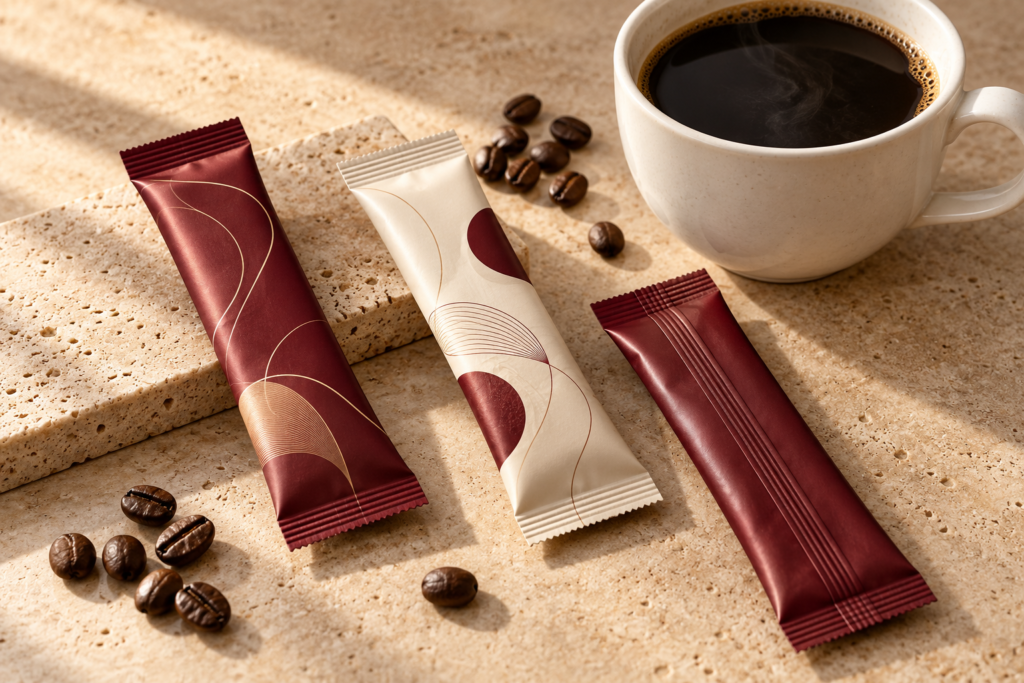
Coffee & drink mix packaging concepts.
AI-generated
Application / 01
Coffee & drink mixes
Instant coffee, tea powders and other drink mixes can use slim packs for measured portions that are easy to carry and prepare.
Fill weight is only the starting point. Powder density, flow and the space needed for reliable sealing also influence the finished size.
Match dimensions to fill volume and powder flow
Assess moisture, oxygen and aroma protection
Keep product away from the sealing area
Application / 02
Oral care & personal care
Slim sachets may suit measured portions of selected liquids, gels and personal-care formulas when the material and sealing system are appropriate.
Review formula compatibility, dispensing and opening behavior together. A neat appearance should be supported by checks on the filled pack.
Check formula and laminate compatibility
Plan a controlled opening and dispensing point
Validate seal integrity and leakage performance
Slim-format personal-care packaging concepts.
AI-generated
Start with the product requirements.
Contents and consistency, storage conditions, protection needs and filling equipment should guide the packaging specification. Confirm the proposed structure through product-specific trials.
03 / Design details
Small pack. Considered details.
Shape, print & opening details.
A compact pack brings every detail into focus. Review the dimensions, artwork and opening style as a connected design.
01 / DIMENSIONS
Find the right proportion.
Allow for the contents, headspace and seal areas. Confirm whether quoted dimensions refer to the finished pack or the film layout, and review them with the filling team.
02 / ARTWORK
Give the front a clear focus.
Prioritize the product name and essential information. Keep critical text clear of seals, folds and trim areas, using the supplier’s approved artwork template.
03 / OPENING
Make the first use feel easy.
Consider a suitable tear notch or opening feature. Check tear direction, grip and dispensing with filled samples rather than judging the opening from artwork alone.
What to confirm before production
01
Product & fill volume02
Pack width & length03
Material & protection04
Filling & sealing process05
Artwork & opening style04 / Common questions
A few practical answers
Frequently asked questions.
01
Are all stick packs back-sealed?
No. “Stick pack” describes a slim packaging format, while “back-sealed” describes the seam position. Confirm the actual seal construction and film specification for your product.
02
Can the size and artwork be customized?
Custom dimensions and printed artwork can be discussed within the limits of the material, tooling and filling equipment. Confirm the production specification and artwork template before preparing final files.
03
Which material should I choose?
There is no single structure for every application. Selection depends on the contents, compatibility, barrier needs, storage conditions and sealing process. Product trials help confirm suitability.
04
What should I send for a quotation?
Prepare the product type, target fill weight or volume, proposed dimensions, quantity and artwork. Include any known material requirements, storage expectations and filling-machine details.
THE TAKEAWAY
A better pack starts with a clearer brief.
Bring the product, pack dimensions, protection requirements and artwork together early. These details give your packaging team a practical starting point for samples, trials and production planning.